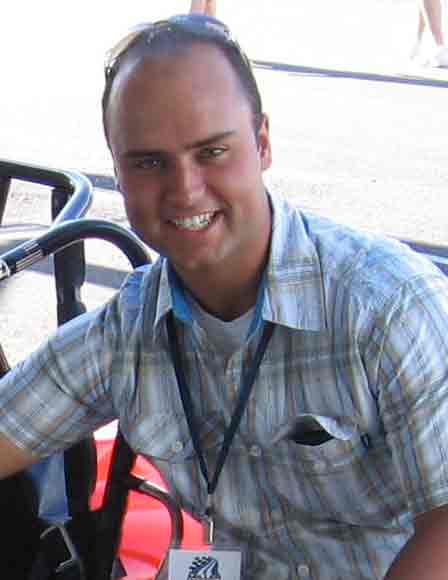
Sunday, October 28, 2007

It's been awhile!

Hello friends. I know I have been busy with other things and I am now ready to get back into the swing of things.

Come back often to read a different auto review I will have posted in here every week!

And as always, don't hesitate to email me if you have any questions or suggestions.

Read on,


Daniel Souza

Thursday, September 06, 2007

2008 Scion xD: A zippy alternative from A to B

By Daniel Souza

Revealed at the 2007 Chicago auto show, Toyota’s sub company Scion hopes to captivate urban-minded drivers with a smaller, gas-sipper, better-looking-than-the-xB subcompact.

The xD's futuristic exterior characterizes it as a Scion with its simple surfaces and sharp lines that flow from front to rear. The vehicle’s wide stance and accentuated wheel flares communicate the urban personality. Other styling cues that set the xD apart include a long and narrow back window, and the Scion family traits—horizontal headlamps, an integrated rectangular lower and upper grille, and turn signals built into the side mirrors.

Designers focused on a clean, comfortable and futuristic interior style. The simple dash features an instrument panel located directly in front of the driver while the center cluster—digital clock and HVAC and audio controls—flows down the center. The xD's unique, radar-like speedometer and tachometer have been consolidated into one circular gauge centered on the instrument panel. Indicator lamps, LCD fuel gauge and odometer flank the centralized gauge.

Scion’s new family addition features front bucket seats and 60/40 fold flat rear seats for a level cargo space. The rear seats can slide forward and back up to six inches for additional leg room and cargo area. In addition, they can recline ten degrees and be adjusted into five different positions, a practice needed when juggling for space in a subcompact.

But the little hatch surprises when it comes to interior room. Up front, the xD has a storage tray located beneath the steering wheel, a small box in the front of the center console for holding portable music players or cell phones, an upper and lower glove box, and driver's side change box. A hidden storage space is located below the rear cargo area.

Under the hood the xD sports a lively 1.8 L four-cylinder engine with dual variable valve timing with intelligence (VVT-i) that generates 128 horsepower.

Customers have the choice of a five-speed manual transmission or a four-speed automatic transmission. This 2ZR-FE engine features a roller rocker system and light weight piston for better fuel economy and a piston cooling oil jet for better efficiency.

Drivers will also be rocking to Scion’s Y-generation musical tastes. The xD's standard 160-watt maximum output Pioneer audio system features iPod connectivity and a mini-jack port located beneath the AC controls for easy access. This standard head unit integrates track, artist and album information from the iPod into a one-line display on the head unit's screen.

Connectivity is achieved by simply plugging the iPod into a port via a connector cable, providing outstanding sound quality through the car's stereo system and constant power to the iPod. Music is controlled through the head unit and the steering wheel audio control buttons. Scion also provided a mini-jack port that allows users to listen to non-iPod MP3 players through the xD's Pioneer speakers.

The xD's optional premium audio system adds one more feature to the standard head unit, the ability to download "skins" to play on the organic electroluminescent (OEL) screen. Customers can download images, four-second video clips and eight-second movies from Pioneer's website. In addition, Pioneer software allows customers to burn their own images and movies onto a CD and upload them onto the available head unit. The faceplate light also changes from deep orange to blue at the touch of a button.

Since many Scion customers add in-car entertainment systems to their vehicle, the xD's optional premium audio system has rear head unit outputs allowing for the addition of external amps to boost power to additional speakers and subwoofers. All head unit features remain unchanged if this feature is used.

As other Scion vehicles, the xD comes mono spec. Customers need to choose exterior color and transmission type, while the only factory option is vehicle stability control with traction control.

As for fuel efficiency, expect 27 mpg/city and 33 mpg/hwy on a 5-speed manual and 26 mpg/city and 32 mpg/hwy with an auto transmission.

Base Price - $14,550

Price as tested - $16,850

Daniel Souza can be reached at sixth.gear.herald@gmail.com or visit his blog at http://sixthgearherald.blogspot.com

Monday, June 25, 2007

AUDI R10 TDI

This is a very nicely done video.

I came across it on You Tube and wanted to share with all of you...

Considering that I got to interview the whole crew that maintains this car (including drivers) when they came to Salt Lake City's American Le Mans Series race, this video seems a bit cooler. Either way it was a well put together production.

Enjoy it!

Thursday, June 21, 2007

All New Last Year, 2007 Range Rover Sport returns with refinements

By Daniel Souza

The combination of a strong V8 power, the shortest wheelbase currently offered by Land Rover North America, and a low, wide stance makes the British vehicle an attractive option for buyers that can fork out sums north of $70k.

The price tag on it may raise the hair on the back of some driver’s head, but the SUV comes packed with enough options as to almost justify writing the big check.

This more muscular-looking Range Rover comes equipped with the popular Terrain Response™ system, also present on other Land rover models. The system provides the Range Rover Sport with a competitive edge in off-road capability—if you can throw a vehicle with this premium price in a puddle of mud. I did.

After finding the perfect off-roading area nested in the heart of Provo Canyon, I decided to take this Brit to its limits. For that I needed help from an off-road expert; my father. Having played his fair share in the mud with the old FJ Cruisers in the late eighties, I knew he could add some value to the whole experience.

At first the Range Rover Sport proved to be confident and responsive. The Terrain Response™ system worked as predicted and gradually steered us through the mud-filled terrain.

Then Souza senior thought the vehicle could go through a soft, lake-like area in our off-road course. Before the adventure, we raised the SUV using the electronically controlled air springs that provide automatic leveling and three selectable ride heights—access (for entry), standard, and off-road.

The exploring began with a confident feel, but soon the Range Rover Sport started to struggle through the clay-like mix of water and dirt. Its pavement-friendly 255/50YR19 radial tires became as slippery as ice skating with only your socks. And though the Terrain Response™ system tried its best to make sense of the mud fest, it was my old man’s expertise and experience that got himself and it out of the ditch. If you plan on doing the same, may I suggest some beefy off-road tires?

But the Range Rover Sport features more than just a grown up backyard toy. Add a choice of two sophisticated V8 engines—Supercharged and naturally aspirated, four-corner independent air suspension, an electronically controlled six-speed automatic transmission, permanently engaged four-wheel drive, plus a long list of premium cabin features and the result is an SUV with a major accent on sport.

Common traits shared by the Supercharged and naturally aspirated V8s that power the Range Rover Sport are aluminum block-and-head construction, chain-driven double overhead camshafts, and four-valve combustion chambers. The 4.4-liter naturally aspirated V8 features electronically-controlled continuously-variable intake and exhaust timing and electronic throttle actuation. Peak outputs are 300 bhp at 5,500 rpm and 315 lb.-ft. of torque at 4,000 rpm.

Training an SUV to behave well both at high speeds on torturous, undulating pavement and while traversing challenging off-road terrain is no mean feat. To advance the Range Rover Sport to a new level of dynamic capability, Land Rover engineers dug deep and employed the best available technology.

To match stopping power with acceleration and speed, both Range Rover Sport models are equipped with high-capacity four-wheel vented disc brakes. Four-piston front disc brakes supplied by Brembo ® are standard on the Supercharged model and optional (with Dynamic Response in the Dynamic Response Package) on the HSE. The parking brake is electronically applied by simply pulling a small console lever.

As for interior amenities, the Range Rover Sports can please both the luxury-demanding (think Oak dark wood or light Cherry Wood trim, soft Lux or sport leather trimmed upholstery) as well as the tech-driver (Personal Telephone Integration System with Bluetooth ® capability, a nice male or female British accented voice, GPS navigation, etc.)

As for gas mileage, the old adage comes true: if you have to ask, you can’t afford.

Base Price - $57,250

Price as tested - $70,250

Daniel Souza can be reached at sixth.gear.herald@gmail.com or visit his blog at http://sixthgearherald.blogspot.com

Monday, June 18, 2007

2007 Land Rover LR3

By Daniel Souza

With interior changes only for 2007, the boxy SUV continues to wow critics (by snatching 25 awards in U.S. product reviews) and captivate drivers (the smart Terrain Response boasts the LR3 with some brain behind all of its muscle) making the vehicle as reliable as British teatime.

The European utility earns a touch of class for 2007 with four popular features—leather trimmed upholstery, a power glass sunroof, a 240-watt harman/kardon® sound system, and steering wheel touch controls—as standard LR3 equipment.

Three models are offered: the LR3 V6 SE is powered by a 216 bhp 4.0-liter V6 while both the V8 SE and the V8 HSE are powered by a 300 bhp 4.4-liter DOHC V8.

The V8 option will enable the driver with an extra, sometimes needed hmmph, where the V6 can be a little more (and I mean very little) conservative on sipping on gas. Or as the English would say, it has proper petrol consumption.

The soul of the LR3 is attributed to its off-road competence. The vehicle comes equipped with Terrain Response™ that automatically adjusts a whole host of electronically controlled systems to suit driving conditions.

At the touch of a knob on the center console, the driver commands the LR3 to orchestrate a series of decisions made by the vehicle.

The LR3 then manages the engine’s throttle response, the transmission’s shift characteristics (and gear selection), the center differential’s operation (and if equipped, the rear differential also), the air suspension, and many dynamic systems including DSC, 4ETC, and HDC, for maximum traction, stability, and control.

The Oreo-sized button can point to 5 different settings: general, grass/gravel/snow, mud/ruts, sand, or rock crawl.

Grass/gravel/snow will maximize traction on firm but slippery surfaces. Wet leaves and grass or hard-packed snow and ice are the perfect conditions for this setting.

As for mud/ruts, this setting can make a dramatic difference on soft, wet ground where some degree of wheelspin is important in order to maintain momentum. Since low range is recommended for this program, the driver will be prompted to switch the transfer gearbox selector when you select this program.

When left on general, Terrain Response™ is never off, and the general setting is compatible with all on- and off-road conditions. Think of this as being comparable to the "automatic" setting on a digital camera.

As for sand or rock crawl mode, let’s just hope you don’t have to go there. If you do, just make sure that you have your owner’s manual nearby.

Graced with all the diversity in terrain response, what truly dropped my jaw (and everyone else that drove it) was when the driver took the feet of the gas pedal. The LR3 calls it Hill Descent Control, or HDC. Easily switched on or off by a bright yellow sign also located in the center console, this setting does the braking for you.

“It’s like driving on-road when we actually are completely in off-road terrain,” said SUV enthusiast Erin Masihdas of Salt Lake City.

To ensure safety, hill descent automatically limits forward speed to 2.2 mph in low range and 3.7 mph in high range.


Now, a few paragraphs back I said that the V6 engine option can offer proper petrol consumption. I would like to ratify such statement by reminding that proper consumption on the V6 happens only when compared with the LR3’s optional V8. The difference comes with a mere extra 1 mpg in highway consumption.

The rectangular-shaped SUV pleases off-road, but it disappoints at the pump with a 14 mpg city and 19 mpg hwy (V6) and 14 mpg city and 18 mpg highway (V8).

Base price - $42,150

Price as tested - $53,950

Daniel Souza can be reached at sixth.gear.herald@gmail.com or visit his blog at http://sixthgearherald.blogspot.com

Wednesday, June 06, 2007

2007 Honda Fit vs. 2007 Nissan Versa: Battle of the Subcompacts


By Daniel Souza

On a constant effort in providing drivers with options to dodge ever rising gas prices, Nissan and Honda add small hatchbacks to their lineup hoping to win big on the battle for a presence in the under-$20K entry vehicle.

The two Japanese makers aren’t fighting alone. The industry realized—some sooner than others—that city-minded drivers want something zippy, economical and something they can brag about to friends.

But to earn drivers’ bragging right is not as easy as it may seem. The entry level market boasts competition from every side. It helped boost the once not-so-popular Korean vehicles (think Hyundai, Kia and Suzuki), it still boasts another tough Japanese competitor (think Toyota Yaris) and it is getting a big push from some a domestic maker, like the Chevy Aveo.

Both Nissan and Honda hope to lure buyers to their sub-compacts with their reputation. Both vehicles are less than a year old to the market. But both of them have proven good business abroad.

The Nissan five-door received its name to reflect its "versatile space" provided by the roomy interior and cargo area. In creating the Versa packaging, the design and engineering teams at Nissan found a way to put a big interior in a small car. The interior length, front to back, is over six feet long.

The Fit doesn’t stay behind though. Dimensionally compact on the outside, the interior provides a surprisingly large passenger and cargo space. At the foundation is the Fit's Magic Seat®, an innovative 60/40 split rear seat that allows the seat backs to fold down or the seat bottoms to flip up, providing five distinct seating and cargo carrying configurations. With all seats in the upright position, passenger volume measures 90.1 cubic feet (slightly less than an Accord Coupe's passenger volume) with 21.3 cubic feet of cargo capacity behind the second row.

Though there’s ample space inside, don’t expect big numbers in engine performance. Both vehicles house a conservative four-cylinder engine that will gasp for a shorter gear when going through a long steep hill (such as the famous point of the mountain).

The Fit boasts a 1.5-liter SOHC 16-valve 4-cylinder VTEC engine generating 109 horsepower at 5800 rpm and 105 foot-pounds of torque at 4800 rpm. The Versa on the other hand comes in first here with a 1.8-liter DOHC inline 4-cylinder turning 122 horsepower and 127 foot-pounds of torque.

The Versa’s engine is powerful and responsive, but it also delivers excellent fuel economy. Estimated fuel economy is 30 mpg city/36 mpg highway with the CVT transmission, 30 mpg city/34 mpg highway with the 6-speed manual transmission, and 28 mpg city/34 mpg highway with the 4-speed automatic transmission.

It beats Honda’s Fit. The three-lettered hatch delivers an estimated 28mpg city/34 highway when mated to a manual five-speed, 27 mpg city/35 mpg highway equipped with a regular five-speed automatic and 27 mpg city/34 mpg highway with its sporty S5 automatic.

On the other hand Honda’s Fit brags a top five-star safety rating for frontal crash performance from the National Highway Traffic Safety Administration (NHTSA). The Versa stays behind here, earning only a four-star rating for frontal crash. As for side crash the Versa earns a top five-star rating while the Fit gets a five-star rating only for front seats. Rear seats received a mere three-star rating as reported by the NHTSA’s safercar.gov.

Though the Fit is a great option as a subcompact, it was the Versa that was fitted with first place having best overall feel and handling, gas consumption and safer option, all with a stronger engine. But before buying any of these, take the time to do a thorough research. It always pays off.

Honda Fit

Nissan Versa

Base price - $13,850

Base price - $12,550

Price as tested - $15,970

Price as tested - $16,550

Daniel Souza can be reached at sixth.gear.herald@gmail.com or visit his blog at http://sixthgearherald.blogspot.com

Tuesday, May 22, 2007

Motors revved up for competition in Tooele

By Daniel Souza

TOOELE – Porsche’s Sascha Maassen and Ryan Briscoe claimed an almost predictable career-first overall win at the fifth race in the American Le Mans Series at Miller Motorsports Park this past Saturday.

A gamble on fuel strategy paid off and gave the team and Porsche its third straight overall victory in the American Le Mans Series with a 10-second victory over Audi's Allan McNish.

"The gas was a bit of concern, but the engineers in the box told me what number to conserve to and they were working with me on that," said Australian native Briscoe, who scored his second career class win.

The Penske team lengthened its final fuel load while Briscoe took the lead in the No. 6 LMP2 Porsche RS Spyder with 40 minutes to go when McNish pitted his diesel-powered No. 1 LMP1 Audi R10 TDI for a final splash.

"On my second lap of the stint I was saving a lot of fuel. They kept me updated as we were going. We knew we at least had the second-place buffer. After the first yellow flag Roger called the best strategy, which put us in the right place," said Briscoe.

The Aussie drove the final 75 minutes relying on a single set of tires and tank of fuel. The sister Penske Porsche of Timo Bernhard and Romain Dumas won overall at Long Beach and Houston. Maassen was one of six cars to pit at the 18-minute mark following an early caution period when a GT2 car became stranded on the track.

But with four different races within the same race, it was Tomas Enge and Darren Turner’s GT2 Ferrari F430 GT that snapped a four-race winning streak for Risi Competizione and its No. 62 Ferrari—also a F430.

The championship-leading car of Jaime Melo and Mika Salo broke a driveshaft with a little more than an hour to go. It was an ill-fated result as the car failed to complete 70 percent of the overall winner's laps to receive points.

And Vegas-based Petersen Motorsports seemed to have a winning plan, besides adversity. Switching from their traditional Porsche entries to the Ferrari F430 GT, the team relied on its driver duo to bring the win home.

“I knew I couldn’t go more than an hour because of my physical condition, but what a nice car to drive,” exclaimed a grinning Enge who two months earlier had smacked the outside wall in St. Petersburg, FLA, suffering a concussion, injuring his ribs, partially collapsing his lungs and fracturing an elbow.

“My worry was on how well I would do. I have to thank everybody for this result,” said Enge who raced with a protective brace on his left forearm.

“When you see a team do what these guys go, it gives you a tremendous lift,” said Enge.

Many of the ALMS teams that competed at Miller Motorsports Park will race next in the legendary 24 Hours of Le Mans on June 16-17. The next ALMS race will be the American Le Mans Northeast Grand Prix on Saturday, July 7 at Connecticut’s Lime Rock Park.


*Photos by Jeremy Henrie

Monday, May 14, 2007

Porsche aims to continue success streak with Utah Grand Prix


Successful start for the Porsche RS Spyder into the 2007 American Le Mans Series: After claiming overall victories in Long Beach and Houston as well as three class wins from the first four races this season, the Penske Motorsports and Dyson Racing teams are keen to continue this success streak in Salt Lake City, in the state of Utah, where the Winter Olympics took place in 2002. The fifth round of the American Le Mans Series, the series with the world's fastest sportscars, takes off here on Saturday.

Located in Miller Motorsport Park, the 7.240 kilometre circuit is not only the longest on the American Le Mans Series calendar but with its 24 corners is one of the most demanding. “A great challenge,“ enthuses title defender Sascha Maassen (Germany), who celebrated class victory and fastest race lap here one year ago at the premiere on the brand new circuit. “It's easy to lose one or two tenths of seconds over the long laps here, so it's very important to concentrate over the entire race distance and avoid making the slightest mistake."

At the second American Le Mans Series race here in Salt Lake City, four RS Spyders roll to the start. The Porsche-supported Penske Motorsports team runs two of the Weissach built sports prototypes: Sascha Maassen and Ryan Briscoe (Australia) man the RS Spyder with starting number 6. Sharing driving duties in the #7 RS Spyder are Timo Bernhard (Germany) and Romain Dumas (France). The duo celebrated two consecutive overall victories within one week at the street races in Long Beach and Houston and with these sensational results took over the drivers championship lead in the LMP2 category.

The US-based Dyson Racing team runs two RS Spyders with assistance from Porsche. Manning the #16 vehicle are Andy Wallace (Great Britain) and Butch Leitzinger (USA), who finished third behind Sascha Maassen and Ryan Briscoe in Long Beach, making the historic triple victory complete for Porsche. Taking up the race in the #20 RS Spyder are Chris Dyson (USA) and Guy Smith (Great Britain).For Hartmut Kristen the race in Salt Lake City holds very special challenges: “After contesting the last three races on very narrow and bumpy city circuits we're now back on a real race track. The cards will be reshuffled,” says the head of motorsport at Porsche. For Kristen, the key to success on this flowing circuit, which from it's characteristics is more comparable to European tracks, is not the pure engine output but the aerodynamic efficiency and stability in the many fast corners. The heat as well can not be underestimated, albeit with the race taking place earlier compared to last year temperatures are expected to be less extreme. He concludes: “This race puts extreme stresses on man and machine, particularly in the fiercely-contested LMP2 category. Spectators can expect a gripping and dramatic race.”

In the equally tough GT2 class for slightly modified near-standard sportscars, Porsche is strongly represented. In Salt Lake City, reigning ALMS GT2 champion Joerg Bergmeister (Germany) together with team mate Johannes van Overbeek (USA) are keen to secure their first class victory of the 2007 season at the wheel of their 911 GT3 RSR fielded by Flying Lizard Motorsports. Recently in Houston the duo finished second ahead of Wolf Henzler (Germany) and Robin Liddell (Great Britain), who will team up in a Tafel Racing 911 GT3 RSR for the Salt Lake City round. Amongst the circle of favourites are also Ralf Kelleners (Germany) and Tom Milner (USA) sharing the cockpit of a 911 GT3 RSR fielded by the famed Rahal Letterman Racing team.The race in Salt Lake City gets underway on Saturday, 19 May at 5pm and runs over 2:45 hours. For ticket information, please visit Miller Motorsports Park. See you there!

Monday, April 30, 2007

2007 Nissan Frontier: The Beach Bum!

By Daniel Souza

The Nissan Frontier was all-new in 2005 when it was completely redesigned. For 2007 it would be safe to call it half all-new, taking into consideration that the model Nissan loaned me featured a new, optional long bed to the Frontier, with a bed that is 13 inches longer than the traditional Crew Cab.

Not much more made into debut for Nissan’s 07 midsize pickup truck. For a truck that shares a number of features with the Titan, the Frontier showed to be a comfortable and dependable ride. The Frontier’s sturdy foundation is based on Titan's F-Alpha platform. The ‘07 Frontier's wheelbase is 9.8 inches longer than the previous generation’s, which enhanced ride comfort and stability, though it remains a good "activity size" for buyers who don't need a true full-size pickup. Unfortunately the Frontier performed under its promised city 17 mpg and hovered around 14.6 mpg with its six-cylinder engine.

The Frontier houses the 4.0-liter DOHC V6 powerplant which is based on the award-winning Nissan VQ engine series used in the 350Z, Maxima, Altima, Murano and Quest. The 4.0-liter V6 design includes a continuously variable valve timing control system (CVTCS), Nissan variable induction control system (NICS), silent timing chain, microfinished camshaft and crankshaft surfaces, Teflon®-coated pistons, resin intake manifold, forged crankshaft, digital knock control system, high capacity muffler, lightweight aluminum block and cylinder heads and 105,000-mile spark plugs. The Frontier V6 is assembled at Nissan's engine production facility in Decherd, Tenn.

But it was more than 2,000 miles away from its manufacturing plant that the Frontier would be tested to its limits. I had remembered a fellow colleague telling me that the Frontier was the vehicle of choice in Huntington Beach’s lifeguard fleet. After some research on the web, I discovered that the city of Huntington Beach indeed used the 4x4 Nissan midsize truck on their fleet. So I called up a travel buddy, made arrangements to stay with another friend and set west to California.

My test drive came equipped with a six gear manual tranny, where the sixth gear had a ratio of 0.769, making it an overdrive gear rarely used for most in-city driving, but it proved practical as I cruised down I-15. The Frontier yielded a mere 19 mpg for highway driving.

As we arrived in Huntington Beach, marine safety lieutenant Michael Beuerlein comprised our welcoming committee. But before I could start firing the questions away, Beuerlein assigned us the driver of one of their Frontiers, marine safety officer John Elser. The 11-year veteran explained the trucks have proven to be both reliable and user-friendly:

Souza- What types of activities do you do with the Frontier?

Elser- We use it mostly to patrol the beach. We also use it to launch a personal watercraft (PWC) into the ocean.

Souza- How far into to the water do you usually go with the truck?

Elser- I back it up into the water until it’s about six or eight inches into the ocean. Then I slam on the breaks and the PWC launches in the water. It all takes less than a minute.

Souza- So in you put the truck through a grueling daily routine it sounds like.

Elser- Yes. Our driving breakdown is 85% sand, 5% asphalt and 10% normal highway use. We also keep our tire pressure at about 20 psi.

Souza-Why do you do that?

Elser- By reducing psi it gives more surface area and better grip.

Souza- Have you had any heroic moments with the Frontier?

Elser- Yes. We have pulled the police Tahoes out of the sand before.

But the trucks aren’t indestructible. Elser explains that the Huntington Beach Marine Safety Division requires the trucks to go through a daily fresh water rinse down ritual. Their fleet totals 11 vehicles with eight Frontiers, two Titans and one Armada.

As I gathered my notes to finish the story in California, I found one thing to be wrong: it went by too fast and before I knew it was time to return to real life.

Base price - $16,050

Price as tested - $27,200

Daniel Souza can be reached at sixth.gear.herald@gmail.com

Thursday, April 12, 2007

2007 Nissan Armada
By Daniel Souza

Big, large, tank, jumbo, immense, spaceship; attempting to describe Nissan’s mammoth-like first full-size SUV can go on, but this week’s Spanish Armada-like test drive has proven to have more identity than solely its size.
With a hefty 5.6-liter 32-valve DOHC V8, the 2007 Armada’s powerplant has been retuned from last year and received an extra 12 ponies, amounting to 317 horsepower and 385-lb feet of torque.
Nissan’s biggest SUV still boasts a 9,100-pound maximum towing capacity. So even if you need that extra hmmph with the loaded vehicle and that Titanic-sized boat, the Armada should be able to pull it off just fine.

An electronically controlled 5-speed automatic transmission with tow/haul mode is standard on every Armada. The transmission utilizes a unique gear set chosen specifically for use in high torque situations, along with an advanced torque converter design for improved fuel economy and an advanced powertrain management program for improved shift quality. The tow/haul mode revises the shift pattern when towing and hauling.

As you take the captain’s seat on the Armada equipped with the tow package, the panel cluster will reveal a not-so-familiar, but convenient transmission temperature gauge. The tow-ready SUV also gets a higher axle ratio along with a receiver hitch, heavy-duty radiator, additional 7-pin wiring harness plug, trailer brake pre-wiring, heavy-duty battery and rear suspension air leveling system. The tow package is standard on the LE model and available for the SE model.

But like most good things in life, all this power will cost you. And soaring gas prices can quickly turn the smile into a frown. Expect a mere 13 mpg for in-city driving. On the highway things don’t get any more promising. Your economy will get shifted to the unpromising 18 mpg bracket.
Beyond the guzzling factor, the Armada—which was introduced to the US market back in 2004—receives an eco-friendly refinement for the 2007 model; the addition of Flexible Fuel Vehicle technology (FFV), allowing drivers to use traditional gasoline or an alternative fuel such as E85, a mix containing 85 percent renewable ethanol and 15 percent gasoline.

On the other hand, big dimensions can be a good thing for Utah’s normally super-sized families (or full paintball teams). The Armada features include standard fold-flat 2nd and 3rd row seats, the most 2nd row leg room in the full-size, choice of 8-passenger seating or 7-passenger, a moderate cargo space behind the 3rd row seat, and a full-length overhead console with six map lights, vents and available DVD entertainment system (which ours had it).

For 2007, the Armada features a rugged, F-Alpha fully boxed frame for enhanced crash performance and long-term durability and an independent double-wishbone rear suspension designed for improved roominess, comfort and responsive handling.
According to Nissan, drivers are aided in the navigation process with this bigger-than-most sized SUV through a standard rear proximity sensor system (back-up obstacle warning) in the rear bumper, offered in all models of the Armada. Certainly other assists—such as a side and front sensors—would ease the task of parking this Japanese tank. A tank that blended perfectly with the paintball field east of the Provo airport.

Many of the interior features get its cues from its smaller sister SUV, the Pathfinder. Key features on our tested SE model include a body color grille, P265/70R18 tires on 5-spoke aluminum-alloy wheels, 8-passenger seating and full-length overhead console, step rails, 6CD in-dash autochanger and rear sonar sensors to aid in parking.
Available equipment packages for SE models include a Bose Package, Leather Package, Sunroof Package and Journey Package, which features the contents of the three previous packages, plus available XM™ or Sirius® satellite radio service.


With the most ground clearance in its class, this SUV will allow you to take it off-roading if you so wish, but you will also need lots of monetary clearance to keep it running on the road due to its bad gas mileage—the number one complaint from its drivers according to Yahoo! Auto user reviews.

Base Price - $34,950
Price as tested - $45,125

Daniel Souza can be reached at sixth.gear.herald@gmail.com